Apple Mac Plus
The Mac Plus was the machine that finally made the Macintosh viable for serious work, bolting real RAM, a real keyboard, and SCSI to the original vision, without losing its soul.
Hardware & Design
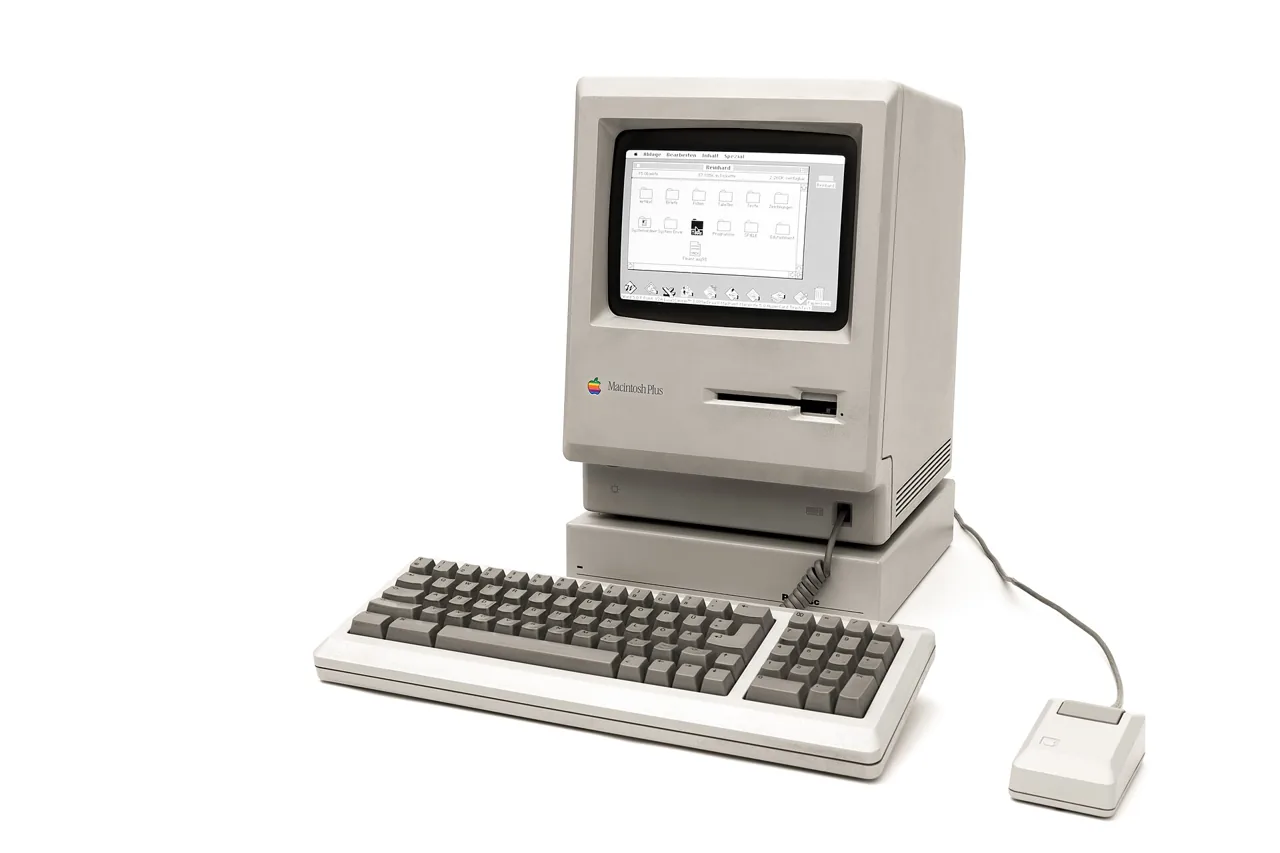
The Mac Plus shipped with 1 megabyte of RAM, a hardwired quantum leap over the 512K "Fat Mac", using CMOS SIMMs, each holding 256K bytes via eight 256K-bit DRAMs in surface-mount packages5. This configuration consumed less power and space than earlier Macs, enabling future expansion; Apple indicated the 256K DRAM chips would support upgrades to 2 or 4 megabytes when 1-megabit chips became available5. The motherboard was redesigned to accommodate the expanded memory and new ROM, though it retained the 68000 CPU at 7.8336 MHz5.
The most tangible user-facing hardware upgrade was the inclusion of an 800K double-sided 3.5-inch floppy drive, capable of reading older 400K single-sided disks4. This doubled storage capacity per disk and improved data transfer rates3. Apple also introduced a new keyboard with a numeric keypad and four cursor keys, bringing it in line with industry standards and reducing reliance on the mouse for navigation4.
For the first time in the Mac line, Apple included a SCSI interface, enabling connection to external hard drives and other peripherals5. This was a critical addition for business users and professionals who needed expandable storage. The ROM was doubled to 128K bytes, housing updated operating system routines that improved performance and compatibility5. A 256-byte EEPROM stored user-settable parameters5.
Software & Interface
The Mac Plus launched without MacWrite or MacPaint bundled, a break from the original Macintosh, which included both5. These applications were available separately for \$125 each5. The system supported Apple's official operating system versions up to System 6.03 and Finder 6.1, with compatibility maintained across this range2.
The expanded RAM and updated ROM allowed the Mac Plus to run more complex applications and multitask more effectively than its predecessors. The SCSI interface enabled reliable use of hard drives such as the Apple Hard Disk 20, which was evaluated alongside the Mac Plus in 19864.
History & Development
The Mac Plus was positioned as the successor to the Macintosh 512K ("Fat Mac")3. Apple offered a formal upgrade path: for \$299, users could install an 800K drive and new ROMs; for \$599 (or \$799 with third-party memory), the entire logic board could be replaced3. Those who had purchased a Fat Mac within 60 days of the announcement received half-price upgrades3.
The Mac Plus was not a clean-sheet design but an evolution, some said a stopgap, intended to bridge the gap until the Mac II and SE arrived7. Its release coincided with a shift in Apple’s attitude toward expandability, notably reversing its earlier hostility to third-party memory upgrades3. The machine’s architecture drew comparisons to the Lisa and Mac XL, with one observer noting the Mac Plus now shared key traits like 1MB RAM and hard disk capability14.
Reception & Competition
The Mac Plus launched at a list price of \$2,5995, though other sources cite \$2,49538. This contrasted sharply with the \$995 Atari 1040ST, which shared similar specs: 1MB RAM, 3.5-inch drive, 68000 CPU, mouse, and keyboard with numeric keypad, but added color graphics and a faster clock38. Critics questioned the Mac’s premium pricing, acknowledging Apple’s software advantage but noting the hardware gap did not justify the cost difference3.
Despite its price, the Mac Plus was seen as essential for business adoption, correcting key shortcomings of earlier Macs4. However, it still lacked some of the necessary features that the business community was demanding from Apple and its Macintosh computer system4. Software incompatibility issues were reported early, echoing problems seen on the Mac XL4.
Legacy
The Mac Plus remained Apple’s base model even after the introduction of the Mac SE and Mac II in 1987, with Apple claiming over 90 percent of existing software would run across the new lineup7. The machine’s longevity was such that third parties like Outbound Systems used Mac Plus ROMs in their notebook computers as late as 1992, adapting them to run on 68EC030 processors10.
In retrospect, the Mac Plus was not revolutionary. It was iterative, pragmatic, and necessary. It fixed the Mac’s most glaring flaws without compromising its simplicity.
Take
The Mac Plus was the first Mac that didn’t feel like a prototype. The original 128K Mac was a statement; the 512K was a correction; the Plus was the first to feel complete. The addition of the numeric keypad alone signaled Apple’s recognition that people used computers for accounting, not just drawing. It was overpriced, yes, and the Atari ST made a mockery of Apple’s cost structure. But raw specs never captured the Mac’s appeal. The Plus delivered an ecosystem: SCSI, expandable RAM, and software compatibility that held firm for years. It wasn’t the fastest, cheapest, or most colorful machine of its time. It was simply the one that worked.
| Processor | Motorola 68000 running at 7.8336 MHz5 |
| RAM | 1 megabyte (expandable to 4 megabytes)45 |
| ROM | 128K bytes of operating system code5 |
| EEPROM | 256 bytes for user-settable parameters5 |
| Floppy Drive | 800K double-sided 3.5-inch drive, backward-compatible with 400K disks4 |
| Expansion | SCSI interface for external storage and peripherals5 |
| Keyboard | New full-size keyboard with numeric keypad and cursor keys4 |
| Operating System | Compatible with System 3.2 through System 6.03 and Finder 5.3 through 6.12 |
| Launch Price | \$2,495–\$2,59935 |
| Announcement Date | Announced in early 198638 |
References
- MacWorks Plus Technical Overview by Chuck Lukaszewski
- MacWorksPlusInstall
- Byte Magazine Atari Articles
- The LisaTalk Report V02 N01 1986 Spring (1986)
- 1986 06 BYTE 11-06 Computers and Music (1986)
- mc-1988-10 (1988)
- 1987.04 Your Computer (1987)
- 1986 04 BYTE 11-04 Number Crunching (1986)
- Interface Age-1981-06 (1981)
- 1992 02 BYTE 17-02 Tomorrows Chips (1992)
- micro 47 apr 1982[ocr] (1982)
- Dafax ROMswitcher
- 1987.04 Your Computer (1987)
- The LisaTalk Report V02 N02 1986 Summer (1986)
- 1982 12 BYTE 07-12 Game Plan 1982 (1982)
- The Rainbow Vol. 03 No. 01 - August 1983 (1983)