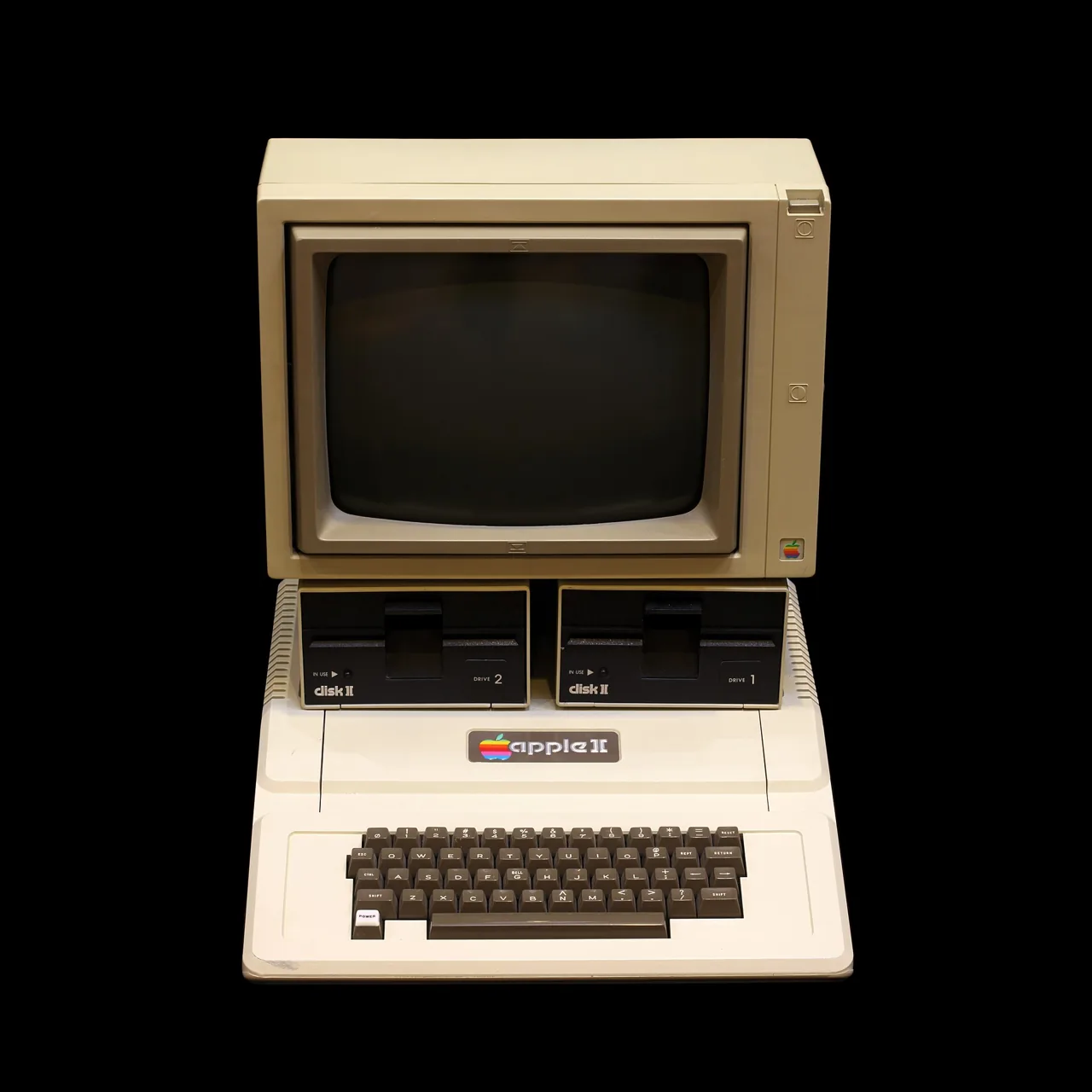
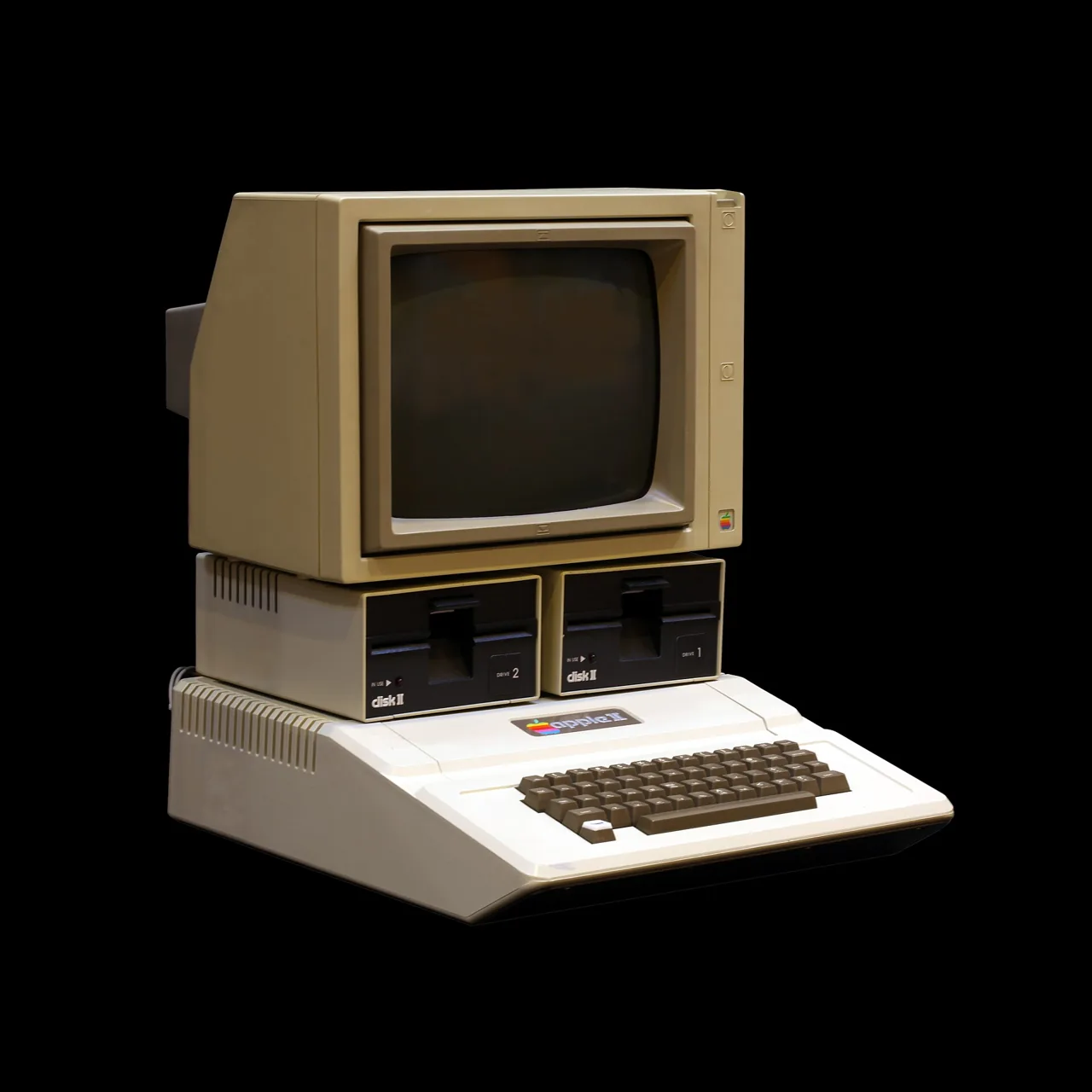
Apple II
The machine that turned Apple from a hobbyist outfit into a professional computer company, and kept selling for sixteen years by being right about expandability at a time when almost everyone else was wrong.
What It Was
The Apple II was a personal computer built around the 6502 processor, sold in a succession of models from the late 1970s through 1993. In aggregate, the line sold almost six million units over those sixteen years.8 That figure is remarkable not because it made Apple the largest computer company in the world (it did not), but because the platform held commercial relevance long enough to see three distinct generations of the same DNA. The original Apple II, the Apple II Plus, the IIe, the IIc, and ultimately the Apple IIGS are all members of the same family, each one backward-compatible enough that software written for the first machine could still run, in emulation, on the last.
The machine came standard with Integer BASIC on the original model; the Apple II Plus came standard with Applesoft BASIC instead.12 That distinction mattered enormously in practice, since Applesoft offered floating-point arithmetic and became the de facto standard for the platform's enormous software library. By the early 1980s, the Apple II held what contemporary observers called the largest software base of any computer on the market.12
Hardware & Expansion
The Apple II's most consequential design decision was its eight expansion slots.12 At a moment when competitors shipped closed boxes, those slots invited an entire cottage industry. Additional CPU boards allowed the machine to run a 6809, a Z80, or an 8088 processor,12 which meant the Apple II could be pressed into service running CP/M software or early DOS applications long before IBM's PC existed. The peripheral ecosystem that grew from those slots was extraordinary: speech recognition hardware, video digitizers, serial cards, 80-column cards, and accelerators all arrived as third-party products.59
Memory configurations ran from 2K through 36K, 48K, and 64K (the last requiring a Language Card).12 The IIe, the line's most popular model, shipped with 48K of RAM and inherited the improved keyboard of the Apple III, along with an option for 80-column output via an add-in card.8 Apple later released an Enhanced IIe carrying a 65C02 processor and 128K of RAM; existing owners could buy an enhancement kit at a suggested price of $70.8 The IIe line concluded with the Platinum version, introduced in January 1987, whose keyboard closely matched that of the Apple IIGS.8 Apple kept the Platinum in production until 1993, when the Apple II line was finally discontinued.8
One hardware peculiarity that shaped the platform's geography: the Apple II's color output depended on manipulation of the NTSC signal. European users required a separate video card to get color at all.8 This was not a minor inconvenience. It effectively split the user base and kept the machine more American than its sales figures might otherwise suggest.
Software & Operating Systems
The Apple II ran DOS 3.3 through most of its early life.12 Apple's Pascal implementation also ran on the platform; the Pascal v. 1.3 package required either two 5.25-inch disk drives or one 3.5-inch drive plus 64K of RAM, and Apple produced separate interpreter versions for 64K systems (covering the Apple II and Apple II Plus) and for 128K Apple IIe computers.16 Pascal on the Apple II was explicitly intended for personal use; Apple's own documentation stated that it had not been upgraded to take advantage of new ROM revisions or model changes, and should not be used to develop commercial software.16 That was an honest admission about the state of the tooling.
ProDOS eventually replaced DOS 3.3 as the standard operating system for the Apple II series, running on the Apple II Plus, IIe, and IIc.1 When the IIGS arrived, Apple bifurcated the OS path: ProDOS 8 became the standard 8-bit operating system working across the IIe, IIc, and IIGS, while ProDOS 16 served as the new 16-bit operating system for IIGS-native software.1 ProDOS 16 version 1.0 shipped with the IIGS at introduction, implemented on a ProDOS 8 core surrounded by a shell handling 16-bit calls; version 2.0 was scheduled for release in the first quarter of 1987.1
The commercial software catalog was genuinely broad. Business productivity, accountancy packages, database tools, word processors, and a dense library of games all appeared for the platform throughout the early 1980s.135 The BYTE index for December 1982 alone lists multiple Apple II game reviews, hardware reviews, and programming articles,5 a reasonable proxy for the platform's cultural weight at that moment.
The IIGS: End of the Line
The Apple IIGS, released in late 1986, was the final and most capable Apple II variant. It contained, in a sense, two machines: the full IIGS with its new 16-bit features, and a 128K Apple IIe in emulation.1 Its QuickDraw II graphics layer was designed with compatibility to the Macintosh's QuickDraw in mind, making it easier for Mac developers to port software across.1 The path to the IIGS was not smooth. The machine's name changed repeatedly in the rumor cycle, and even after release, getting reliable technical information proved difficult enough that a community of dedicated developers began pooling their own findings just to understand what they were working with.15
Well into the 1990s, third-party hardware suppliers were still stocking replacement CPU chips, accelerators, hard-to-find peripherals, and refurbished systems for the Apple II and IIGS.2 The Western Design Center, for instance, was listed as a source of replacement and high-speed CPU chips for both platforms.2 Apple itself continued supporting Apple II developer technical sessions as late as 1990, covering system software, graphics, animation, and sound tools for the IIGS.3
Specifications
| CPU (original / Plus) | MOS 6502; Integer BASIC in ROM (original), Applesoft BASIC in ROM (Plus)12 |
| CPU (Enhanced IIe) | 65C028 |
| RAM configurations | 2K, 36K, 48K, and 64K (with Language Card); IIe shipped with 48K, Enhanced IIe with 128K128 |
| Expansion slots | Eight, accepting peripheral and CPU cards including Z80, 6809, and 8088 co-processor boards12 |
| Color output | NTSC signal manipulation; European users required a separate video card for color8 |
| Operating systems | DOS 3.3; ProDOS (II Plus, IIe, IIc); ProDOS 8 and ProDOS 16 (IIGS)121 |
| Pascal support | Apple II Pascal v. 1.3; required two 5.25-inch drives or one 3.5-inch drive plus 64K RAM; separate interpreter builds for 64K and 128K systems16 |
| Total units sold (all models) | Almost six million over sixteen years8 |
| UK launch price (Apple II) | £1,1958 |
| UK price (IIe at launch) | £1,2958 |
| Enhanced IIe upgrade kit | Suggested retail price $708 |
| IIe Platinum introduced | January 1987; discontinued with the Apple II line in 19938 |
Legacy
The Apple II propelled Apple from an amateur outfit to a professional company.8 That is a large claim, but it holds up: the platform's success in schools (Apple aggressively pursued educational sales to gain credibility and spread the platform to students, parents, and teachers) gave the company financial stability and institutional recognition that the Apple III and Lisa never came close to matching.8 The Macintosh inherited the halo, not the architecture; the Apple II line ran in parallel for nearly a decade after the Mac's introduction, sustained by loyalty, software depth, and the educational market's legendary resistance to switching platforms.
The emulation community around the platform has never fully dispersed. Products like the Apple II Pi — a Raspberry Pi-based card that can emulate a maxed-out Apple IIGS while integrating physical Apple II peripherals — continue to be documented and sold.10 That a machine whose lineage ends in 1993 still supports active hardware development decades later is not sentiment. It is the reward for having eight expansion slots and a software library that contemporary observers correctly identified as the largest of any personal computer of its era.12
References
- BYTE Vol 11-10 1986-10 Apple II GS (1986)
- A2Web AppleIIHardwareSuppliers
- Apple Direct Vol 2 No 10 199007 (1990)
- 1982 12 BYTE 07-12 Game Plan 1982 (1982)
- Computers that made Britain v1
- AcornUser081-Apr89
- 963826
- micro 50 jul 1982[ocr] (1982)
- ComputingToday198201 (1982)
- 1988.08 Your Computer August 1988 (1988)
- APDAlog 199104 (1991)