▚ computopedia.com

Apple IIgs

The most powerful Apple II ever built arrived in late 1986 carrying a 16-bit processor, a color palette that embarrassed its contemporaries, and a price tag that kept it perpetually out of reach.

What It Was

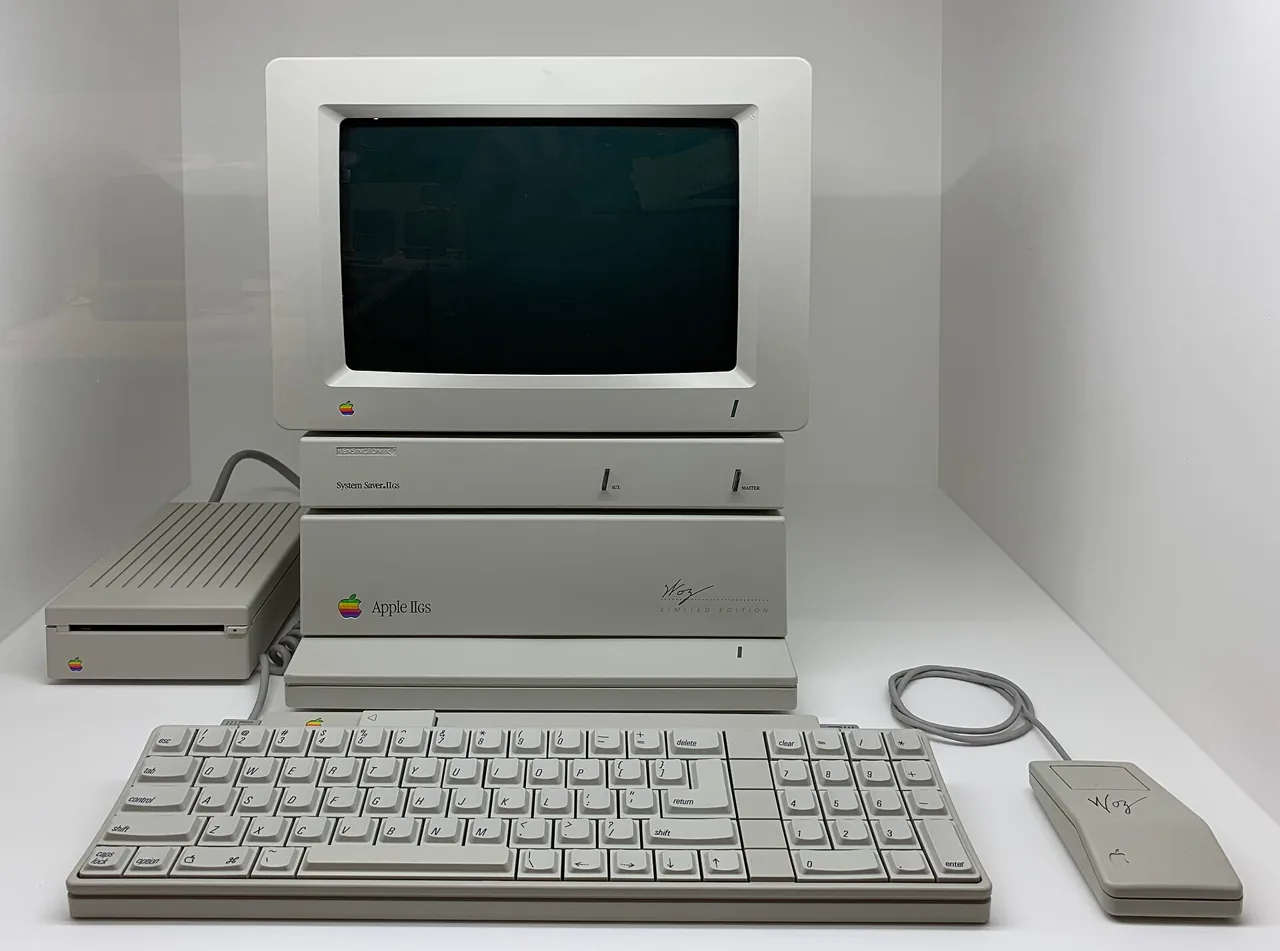
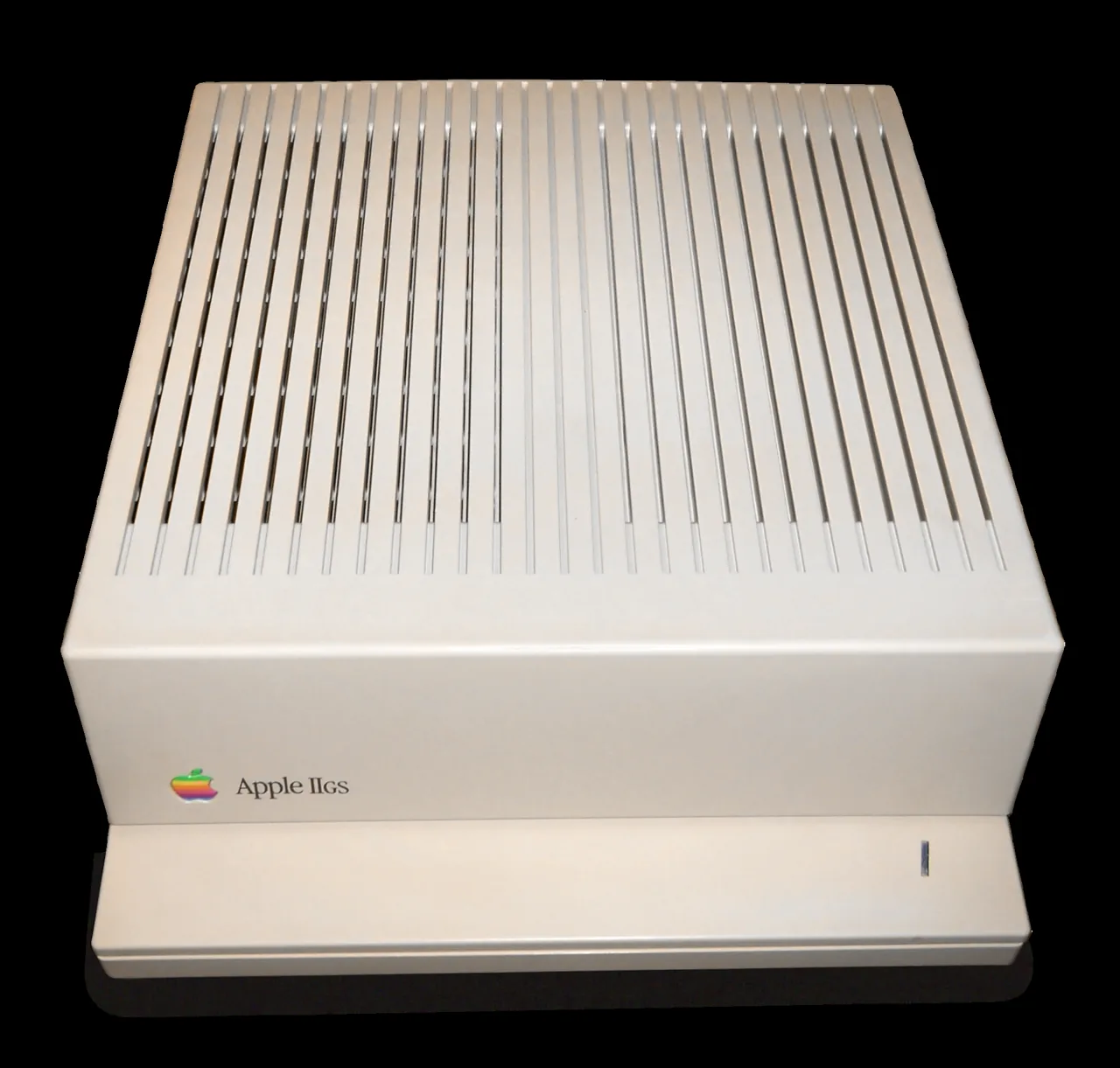
The Apple IIgs occupied an awkward and fascinating position in the personal computer market of the late 1980s. It was simultaneously the apex of a product line stretching back to 197711 and a machine Apple itself seemed ambivalent about promoting too aggressively, lest it undercut the Macintosh. For users willing to pay, it offered graphics and sound capabilities that the plain Apple IIe and IIc could not approach, full backward compatibility with years of Apple II software, and a desktop interface that was genuinely competitive with what was available on more expensive machines.

The machine took years to arrive under a stable name. Anticipated for some time as the "Apple IIx," its name changed repeatedly, and in late 1986 the Apple IIGS was finally born.7 The wait bred a community of dedicated developers who began trading technical discoveries among themselves precisely because Apple's own staff were, as one contemporary observer noted, either uninformed or unwilling to talk.7

Hardware

At the core was a 16-bit 65C816 processor, running at a clock speed of 1.0 to 2.8 MHz.15 The 65C816 was a natural evolutionary step from the 6502 family that had powered every Apple II before it, which meant the IIgs could run legacy software in an 8-bit compatibility mode while its own native applications addressed a full 16-bit data path. Rumors circulated in the developer community that Apple was planning a future revision (the so-called ROM 04 GS) featuring a 7 MHz 65816, which would have been a genuine step forward. Surviving documentation suggests this machine never materialized as a shipping product.3

RAM shipped at 512K, expandable to 8 Mbytes.15 The second edition of the Apple IIGS Hardware Reference was specifically revised to cover the 1 MB Apple IIGS configuration, which became the more common baseline as memory prices allowed.2 ROM measured 128K, expandable to 1 Mbyte.15

Graphics were the machine's showpiece. The IIgs supported up to 650 dots horizontal and 195 vertical with 16 colors available from a palette of 4,096.15 The rumored ROM 04 revision was said to extend this to a 640×480 resolution while retaining the 4,096-color palette, and would have added a dedicated graphics coprocessor. No shipping machine reflected this.3 Both high and low resolution screen modes were supported.15

The expansion architecture provided eight slots, one dedicated to memory.15 There were seven general I/O ports.15 The keyboard was a standard QWERTY layout with a 14-key numeric pad, and could be configured via the Control Panel for either QWERTY or Dvorak layouts across nine international layouts.15 Display options included both monochrome and color monitors; the color monitor was priced separately at $1,299 (Australian) at launch.15

Specifications

Processor16-bit 65C816
Clock speed1.0 to 2.8 MHz
RAM512K standard, expandable to 8 Mbytes
ROM128K, expandable to 1 Mbyte
GraphicsUp to 650 × 195 dots; 16 colors from a 4,096-color palette; high and low resolution modes
Expansion slotsEight slots (one for memory)
I/O portsSeven general ports
KeyboardQWERTY with 14-key numeric pad; Dvorak and nine international layouts via Control Panel
IntroducedLate 1986
Base price (AU, at launch)$2,660 (512K); color monitor $1,299 additional

ROM Versions & System Software

The IIgs shipped across multiple ROM revisions that Apple treated as distinct enough to warrant separate documentation. ROM version 01 came with the Apple IIGS Owner's Guide. Later revisions shipped with Getting Started With Your Apple IIGS for setup and a separate Apple IIGS Owner's Reference covering the hardware alongside system software version 5.0.1 Version 5.0 replaced the earlier System Disk and System Tools guides with a unified Apple IIGS System Software User's Guide.1 By mid-1990, Apple IIGS System Software v. 5.0.2 was available through APDA for $30.00.4

The system software architecture revolved around a Toolbox, a set of callable routines resident in the machine. Apple published toolbox documentation in multiple volumes; Apple IIGS Toolbox Reference, Volume 3 was still appearing in beta draft form through APDA in early 1990,4 which gives some indication of how long the platform's reference documentation lagged behind the hardware itself. The Apple IIGS Hardware Reference, second edition, ran to 300 pages and covered assembly-language programming and hardware design in detail, sold through APDA for $26.95.2

Rumors of GS/OS 6.0 circulated in developer channels, described as adding an SCSI Manager and drivers for Apple's own scanner and LaserWriter hardware, along with support for Microsoft's TrueImage standard. Whether this version shipped is not confirmed in surviving documentation reviewed here.3

Networking

The IIgs supported AppleTalk networking, with Apple publishing a dedicated AppleTalk Network User's Guide for the Apple IIGS as part of the system software 5.0 package.1 In a networked configuration the machine could connect to an AppleShare file server (which itself ran on a Macintosh), and Apple produced a specific supplement addressing Apple II workstation procedures for administrators managing mixed-platform networks.1 The physical layer used LocalTalk cables.1 This was not a trivial capability for 1989; a classroom full of IIgs machines talking to a central file server was a real deployment scenario, and Apple's Apple IIgs College developer event, first held in spring 1987 with a second edition in 1990, included sessions covering the Apple IIGS operating system and tools, programming strategies, and debugging techniques for Apple II developers.6

Software & Development

By late 1988 the IIgs had established itself as the Apple II platform serious developers were targeting. At AppleFest Boston that year, observers noted that the most technically ambitious Apple II software, with the exception of some desktop publishing titles, was being written for the IIgs. Applied Engineering's Audio Animator, a MIDI-equipped board for the machine, was cited as a representative example of the kind of hardware-software integration the platform made possible.12

Sierra On-Line treated the IIgs as a distinct target platform, listing it alongside MS-DOS, Mac, and Apple II in their order forms and requiring 512K minimum for their titles.1314 Mindscape similarly published IIgs-specific SKUs. King of Chicago for the IIgs carried its own product number and retailed at $49.95.8 This kind of explicit platform targeting, common in 1987–1989 catalogs, dried up markedly as the decade turned.

Apple's own development tools available through APDA included Apple II Pascal v. 1.3 with Device Support Tools at $125.00,4 and a BASIC interpreter for the IIgs featuring structured programming constructs, SANE numerics, and full Toolbox access. That interpreter required a minimum of 512K RAM and one 3.5-inch drive, priced at $69.95.2 HyperCard IIgs, Apple's hypertext environment for the platform, required at least 1.5 MB of RAM and system software 5.0.4 or later, and also required either a hard drive or a network environment, which effectively put it out of reach for minimally configured machines.2

The Price Problem

The IIgs was already the most expensive Apple II on the market when Apple raised its price by $100 in late 1988, citing a dramatic rise in DRAM chip costs. Contemporaries noted that this explanation did not account for a simultaneous price increase on the chipless monitor.5 The increase alarmed IIgs-focused software developers directly: fewer machines sold meant a smaller installed base, which meant weaker sales justification for IIgs-specific development. Some publishers who covered multiple platforms were openly weighing whether to scale back IIgs work.5

The reaction was not merely economic anxiety. Buyers had spent years watching computer prices fall as manufacturing improved; a price increase on a machine Apple appeared reluctant to market aggressively read, correctly, as a sign of institutional ambivalence. The IIgs was described at the time as already difficult to move out of dealer showrooms before the hike.5

Legacy

The IIgs was a machine that deserved better institutional support than it received. Its graphics and sound capabilities were genuine achievements for the price class, its backward compatibility with the Apple II library was a real advantage, and its developer community, forged in part through necessity since Apple's own documentation was slow and incomplete, produced serious work. The hardware lived long enough to become the target of emulation: the GSport Apple IIgs emulator later powered the Apple II Pi project, which used a Raspberry Pi as a co-processor to run a "maxed out" IIgs configuration while passing physical peripherals through to Linux.11

What finished the IIgs was not technical obsolescence so much as corporate positioning. Apple had two platforms; one of them had to lose. The IIgs lost, and the software ecosystem that had begun assembling around it dissolved accordingly. The machine the Apple II faithful had waited years for turned out to have a shorter window than anyone had hoped.

References

  1. AppleTalk Network User's Guide for the Apple IIGS (1989)
  2. APDAlog 199104 (1991)
  3. STR411.TXT.generated
  4. APDA Recent Releases 199005 (1990)
  5. Compute Issue 104 1989 Jan (1989)
  6. Apple Direct Vol 2 No 10 199007 (1990)
  7. 1988.08 Your Computer August 1988 (1988)
  8. MindscapeInc.ProductCatalog1987 (1987)
  9. 963826
  10. Compute Issue 100 1988 Sep (1988)
  11. Sierrafall1988 (1988)
  12. SevenNewAdventuresFromSierraAndTigersoftware1989 (1989)
  13. 1987.04 Your Computer (1987)