Sega CD
Sega released the Sega CD in late 1992 as a CD-ROM add-on for the Genesis, pairing a 68000 CPU and 6 megabits of RAM with a 150KB/sec drive to expand the console’s storage and audio capabilities.
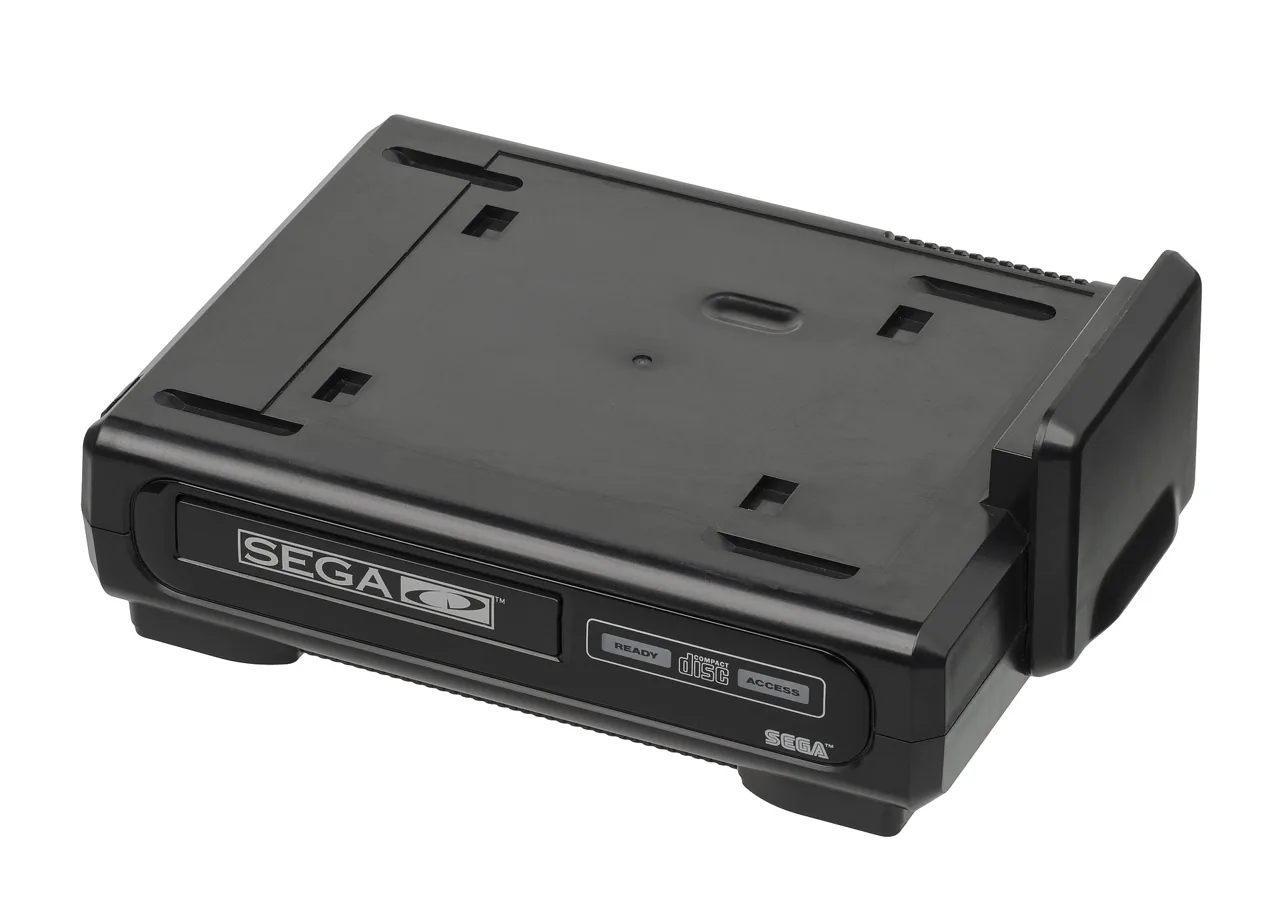
Sega CD was not a standalone console but a peripheral designed to attach beneath the Genesis, augmenting its capabilities with CD-based media1. Marketed as a leap into interactive multimedia, it arrived in North America during the 1992 holiday season with a price of $299.995. The unit incorporated a second processor, reportedly a 68000 CPU, running at over 12 MHz, though one source lists the clock speed as 12.5 MHz5. The designation "MC 6800" appears in a comparison chart, but its relevance to the actual installed processor remains ambiguous given the conflicting 68000 references5.
The architecture relied on parallel processing: while the Genesis handled gameplay, the Sega CD could pre-load and decompress data into its own 6 megabits of RAM, then transfer it rapidly via a dedicated 68000-to-68000 link1314. This design aimed to mitigate the CD-ROM’s relatively slow 150KB/sec data transfer rate, a bottleneck common to early CD-based systems1314. Graphics capabilities remained identical to the Genesis, with no enhancement to color palette or sprite handling5. Audio, however, expanded to 8-channel stereo, enabling richer soundtracks and voice samples5.
Sega of America delayed the launch compared to Japan’s Mega-CD, citing the need for a stronger software library after the Japanese CD add-on suffered from weak third-party support1. By launch, Sega had secured commitments from Tengen, Bignet, Sony Imagesoft, Electronic Arts, and Virgin Games5. Initial titles included Night Trap, Sherlock Holmes: Consulting Detective, Sol Feace, and a compilation disc bundling Streets of Rage, Golden Axe, Columns, and Revenge of Shinobi15. A rock ‘n’ roll CD+G sampler was also listed, underscoring Sega’s push toward multimedia5. Cobra Command was slated for arcade-style release on the platform1.
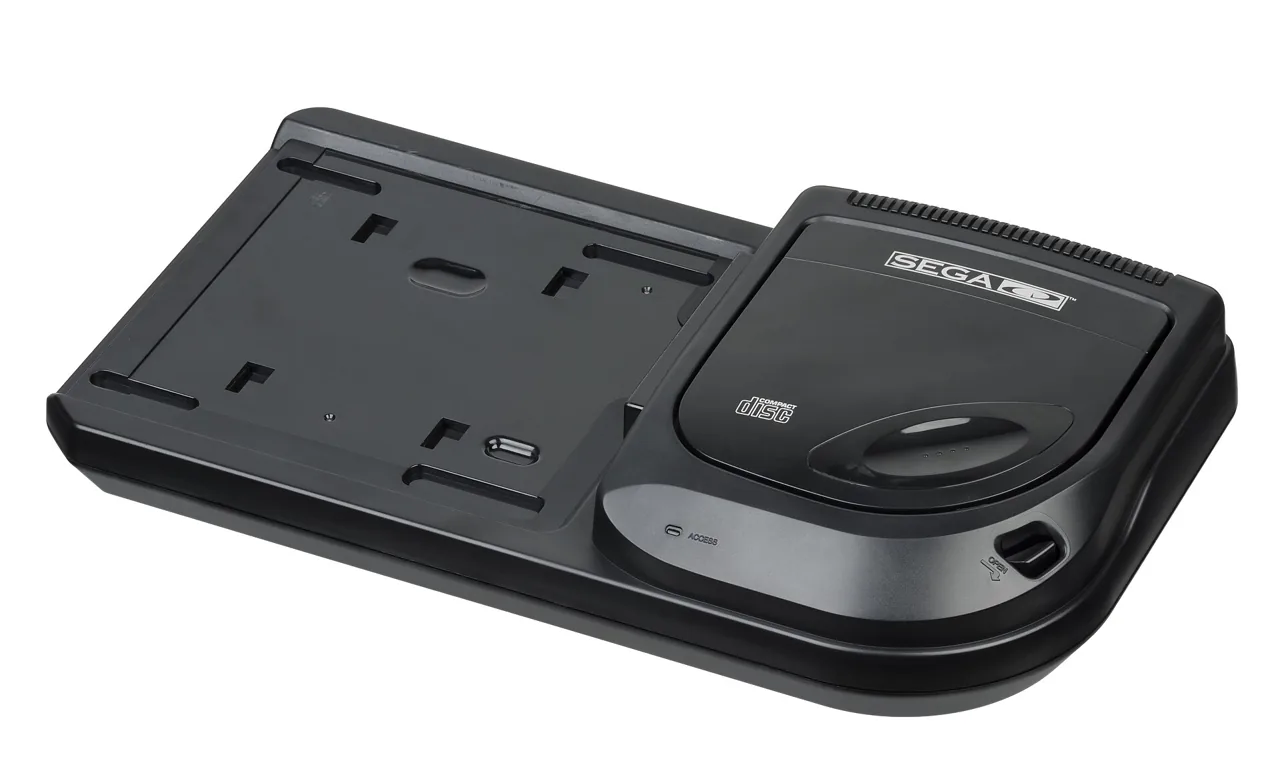
A collaborative model with AIWA, the CSD-GM1, combined the Mega-CD with a radio and cassette deck, retailing at approximately £300 and released in Europe on September 1, 199412. This hybrid unit reflected Sega’s broader ambition to position CD-based gaming within the home entertainment stack, though its niche appeal limited reach. The Mega CD II, a later revision, appeared in European pricing lists alongside the Mega Drive II, suggesting a streamlined form factor, but surviving documentation does not clarify technical differences4.
Despite its technical ambition, the Sega CD faced criticism for high cost, inconsistent software quality, and marginal gameplay enhancements over cartridge-based titles. The reliance on full-motion video and audio tracks, often at the expense of responsive design, revealed the limitations of CD as a gaming medium in this generation. Still, it marked one of the earliest attempts to merge console gaming with mass-storage media, a pivot that would define the next decade. The trademarks "Sega" and "Sega CD" are registered to Sega Enterprises, Ltd.8.
Specifications
| Manufacturer | Sega |
| Product type | CD-ROM peripheral for the Genesis console |
| Release | This Christmas (1992) |
| Original price | $299.99 (USD, 1993) |
| Processor | 68000 (secondary CPU) |
| Processor speed | Over 12 MHz (reported as 12.5 MHz in one source) |
| RAM | 6 Megabit |
| Sound | 8 Channel Stereo |
| Graphics | Same as Genesis |
| CD-ROM transfer rate | 150K per second |
| Players | 1 |
References
- Electronic Games - 199210 - Volume 1 Issue 3 (1992)
- Video Games 1993-12 (1993)
- Electronic Gaming Monthly's 1993 Video Game Buyer's Guide (1993)
- Electronic Games 1994-08 (1994)
- 1994-09-Games-Amusement-Pleasure-03 (1994)
- The One (1991-02) (1991)
- The One (1991-02) (1991)