▚ computopedia.com

Sega Genesis

The 16-bit machine that handed Nintendo its first real defeat in the console market, powered by a Motorola 68000 and an attitude Sega's marketing department did not have to invent.

What It Was

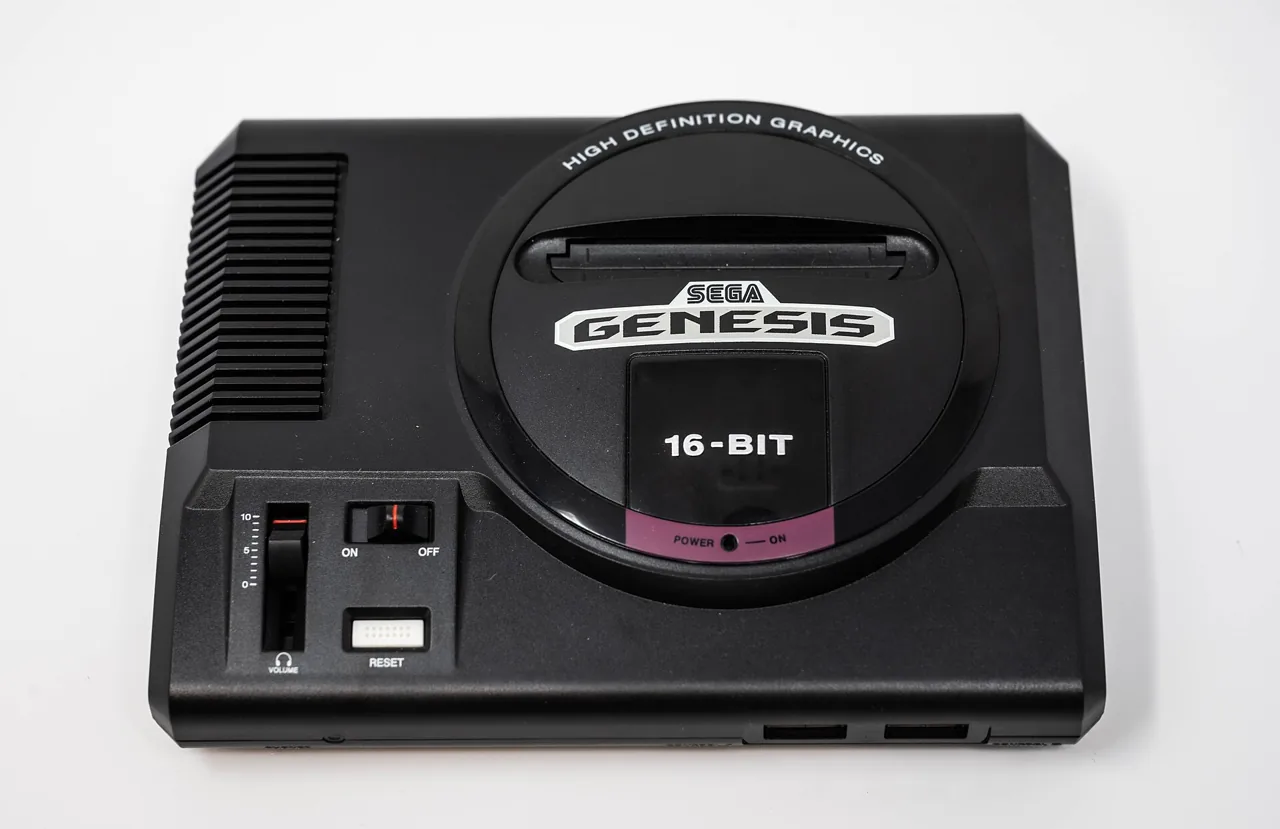
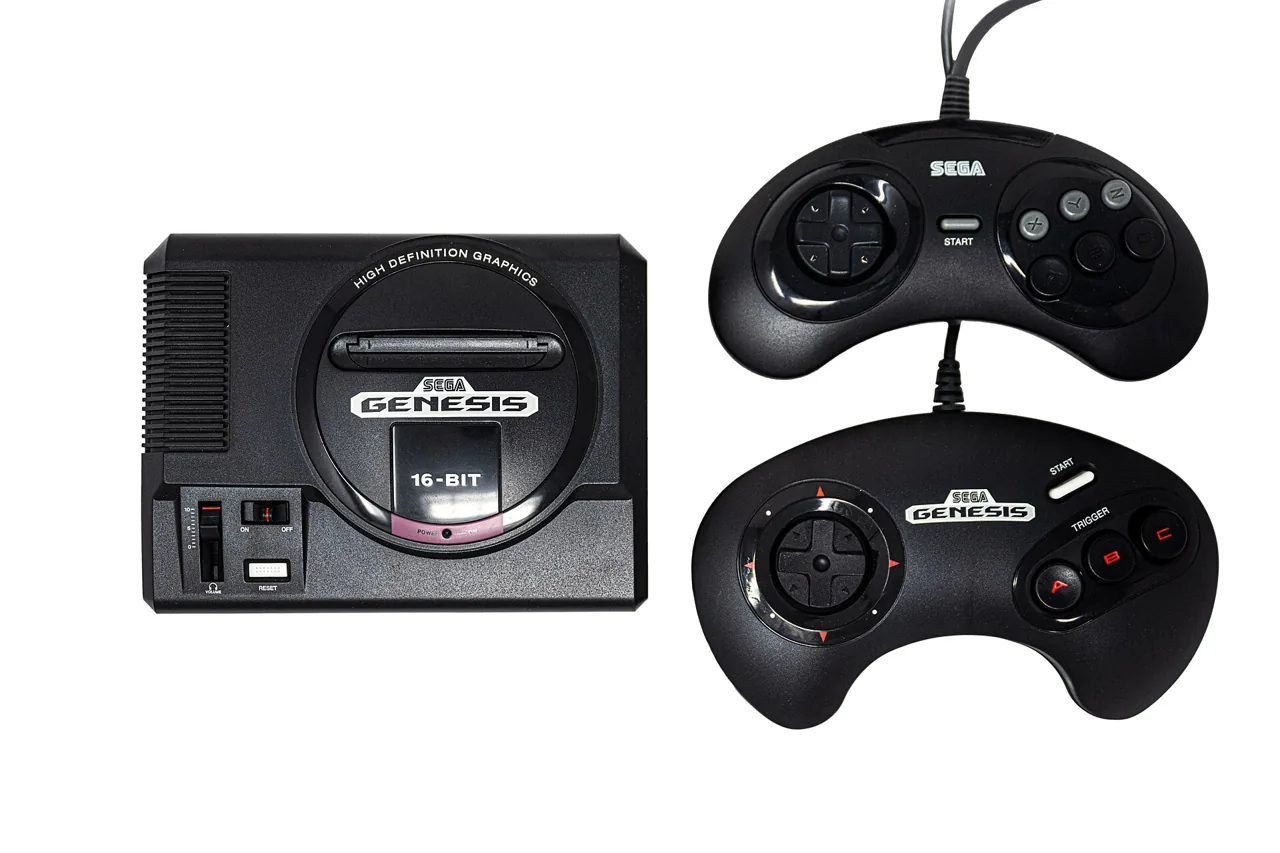
The Sega Genesis is a 16-bit home video game console sold under the name Mega Drive in Japan and most international markets, and as Genesis in North America. Contemporary press described it as "the first true arcade-quality video game on the market," built around the same 16-bit technology used in coin-operated arcade hardware of the period.11 That was not mere marketing: the central processor was a Motorola 68000, the same CPU found in the Atari ST and early Macintosh, running at over 7 MHz, more than twice the clock speed of the Super NES's 65816 at 3.58 MHz.815 In terms of raw throughput for the kind of fast, scrolling, sprite-heavy games that defined the era, that gap was immediately legible on screen.

The system consisted of a console that connected to any television or monitor. Hardware features included high-resolution graphics, the ability to display more than 500 colors, two simultaneous and independently scrolling game fields, and stereo sound accessible either through a headphone jack on the unit itself or via an amplifier or receiver connected to the unit.11 An 8-pin DIN connector on the rear of the console provided both RGB and composite video output, though Sega used an unusual pin spacing that defeated standard DIN connectors available from most electronics suppliers, a detail that made RGB extraction a small adventure for hardware hackers of the era.13

Launch & Market Entry

During the Summer Consumer Electronics Show, Sega announced a September 1989 US debut for the Genesis.9 American retailers were not enthusiastic: NEC's PC Engine, renamed the TurboGrafx-16 for the US market, was due on shelves the same month, and at least one retailer told Sega directly that NEC was "going to blow you out the water."9 The skepticism proved unfounded.

On August 14, Sega shipped a limited quantity of consoles to stores in New York and Los Angeles at a price of $199.99. By September 15, the rest of the country received its allocation, with a $10 price drop applied.9 The NEC TurboGrafx-16 carried a retail price of $199.11 Sega bundled titles including Arnold Palmer Tournament Golf and Tommy Lasorda Baseball alongside arcade conversions such as Golden Axe, a combination that demonstrated the machine's arcade credentials from day one.9

The Genesis also offered backward compatibility with Sega's prior 8-bit hardware through the Power Base Converter, sold separately at around $30, which allowed Master System cartridges to run on Genesis hardware. The reverse was not possible: Genesis software required hardware capability the Master System simply did not have.1

Hardware

CPUMotorola 68000, running at over 7 MHz
Resolution320 × 224 standard
Colors available512
Colors on-screen64
Maximum sprites80
Maximum sprite size64 × 64 pixels
AudioStereo; headphone jack on unit, plus amplifier or receiver connected to the unit
Video output8-pin DIN connector carrying RGB and composite video; unusual pin spacing incompatible with standard DIN connectors
Backward compatibilitySega Master System cartridges via Power Base Converter accessory (~$30)
Launch price (US)$199.99 (August 1989, New York and Los Angeles); $189.99 by September 15 nationwide

The 68000's specification advantage over the SNES processor was concrete and consistent: Sega's developers had also accumulated a two-year lead on SNES developers in learning to extract performance from their hardware, a gap that showed in software quality through at least 1992.815 Where the SNES countered with its Mode 7 scaling and rotation hardware, the Genesis had no direct equivalent, a limitation that industry observers were noting plainly by late 1992, when users familiar with Mode 7 were asking why Genesis could not match it.6

The 16-Bit War

By the early 1990s the Genesis had captured the majority of the 16-bit console market.3 The turnaround from retailer skepticism to market leadership is one of the cleaner reversals in consumer electronics history. Much of the credit went to Sega of America's management under Tom Kalinske, who overhauled product lines, improved consumer support, and positioned Sega aggressively against Nintendo on issues including the video game violence controversy.3

The contest was not frictionless. By 1992, Nintendo's Super NES library was growing steadily while Sega appeared dependent on third-party publishers for compelling new software. Several first-party titles (Fantasia and Taz-Mania were singled out by critics) offered impressive graphics saddled with awkward play mechanics.6 By 1993, the editorial consensus at Electronic Gaming Monthly was that despite the Genesis being "a phenomenal system," that year's software quality edge belonged to the Super NES, which had received a larger volume of quality titles while the Genesis had gone for extended stretches without a major release. The absence of hardware scaling and rotation was cited specifically as a growing liability.5

Expansion & Peripherals

Sega's expansion strategy for the Genesis was unusually aggressive, and not always coherent. The Sega CD, a CD-ROM drive that attached to the Genesis, brought hardware scaling, rotation, zoom and fading of sprites, full motion video capability, and dual processors working in parallel; its boosted clock speed of 12.5 MHz and 6 megabits of RAM extended the platform substantially.5 Sega of America held back the US release of the CD drive until it had assembled a credible software library, having watched the Japanese Mega Drive CD rollout stall due to weak software.6 Once launched, the Sega CD drew support from publishers including Tengen, Bignet, Sony Imagesoft, Electronic Arts, and Virgin Games.5

The Genesis Super 32X, announced in 1994 and positioned as a 32-bit upgrade peripheral, was Sega's attempt to bridge the Genesis platform toward the next hardware generation. The plan, as described by Sega of America at the time, was for the 32X to arrive that Christmas, sustain the Genesis through 1995, and then retire alongside it after the 1995 holiday season as the Saturn (Sega's dedicated 32-bit system) came down to mass-market price levels below $300.7 The Saturn itself was projected to launch in the US in mid-1995 at a price above the combined cost of a Genesis, Sega CD, and 32X adapter.7

The Sega Channel, a cable-delivered game service using the Genesis as its base system, was announced for that same fall of 1994, having already secured agreements with most major cable providers.3

Hardware revisions accumulated over the platform's life. The third major hardware iteration, the Genesis 3, had notably smaller production runs than its predecessors and became the most sought-after standard revision among collectors, partly for its compact design. The Sega Nomad, a handheld version of the hardware sold in the US, was compatible with US Genesis cartridges, Japanese cartridges, and some PAL titles, with the general rule of thumb being that games from before 1991 and after 1994 tend to work, though trial and error remains the only reliable method.9 The Genesis CDX was a further hardware variant in the Genesis line.12

Software & Legacy

The Genesis library covered a wide spectrum, from Sega's own arcade conversions to major third-party titles. Third-party publisher support was substantial: companies like Electronic Arts were active on the platform from early in its life, and by the Sega CD era the roster of CD licensees had expanded considerably.5 High-profile licensed titles appeared regularly. Disney's The Lion King, published by Virgin Interactive Entertainment, was among the notable releases of 1994.16

The platform's trajectory after 1994 was managed decline by design. Sega's own published strategy accepted that the Genesis would be superseded, using it as a mass-market floor while the Saturn established itself at the premium end. Whether the 32X bridging strategy served consumers or confused them is a question the sales figures eventually answered. The surviving documentation from Sega of America's own spokesmen shows the company understood its Genesis install base as an asset to be held, not a platform to be sustained indefinitely.7

The Genesis remains among the most collected 16-bit platforms, with hardware variants and regional editions driving an active secondary market. The core machine's case for itself was always straightforward: a fast processor, genuine arcade DNA, and an early market lead that Nintendo took years to neutralize.

References

  1. Winner's Guide to Sega Genesis (1990) (1990)
  2. Electronic Games 1994-06 (1994)
  3. Electronic Gaming Monthly's 1993 Video Game Buyer's Guide (1993)
  4. Electronic Games - 199210 - Volume 1 Issue 3 (1992)
  5. Electronic-Games-1994-09 (1994)
  6. Video Games and Computer Entertainment - Issue 40 - May 1992 (1992)
  7. EDGE.RETRO.N3.2003.Guide.collecting-DURiAN (2003)
  8. Analog Computing 79 1989-12 Double Megafile Storage (1989)
  9. 6489137
  10. The Rainbow Vol. 10 No. 02 - September 1990 (1990)
  11. Video Games and Computer Entertainment - Issue 40 - May 1992 (Compressed) (1992)
  12. lionkingofficial00rich 1 (Removed Duplicate Pages)