▚ computopedia.com

NeXTSTEP

The operating environment that shipped object-oriented computing to working programmers years before anyone else, on hardware most people could not afford, with an interface that made everyone else's look like a rough draft.

KernelMach (version 2.1 on NeXTStation)16, providing 4.3BSD compatibility, ports-based IPC, memory-mapped files, threads, and expanded virtual address space16
BSD compatibilityUNIX BSD 4.3 utilities7
CompilerGNU C Compiler version 2.2 (Free Software Foundation), supporting C, C++, and Objective-C6
Core componentsWindow Server, Application Kit, Interface Builder, Workspace Manager8
Display systemDisplay PostScript7
Development languageObjective-C7
Bundled applicationsWriteNow, Digital Librarian, Mathematica7
Early release scheduleRelease 0.8 (shipping), 0.9 (expected late Q1 1989), 1.0 (expected late Q2 1989)7
Intel releaseNeXTSTEP for Intel 3.11; NextStep 3.2 User ($795), Developer ($2,995)6
OpenStep basisOpenStep API derived from the OS-independent subset of NeXTStep 3.210
IBM licenseNextStep licensed to IBM to broaden the developer market9
Support contact (Intel)(800) 848-63981

What It Was

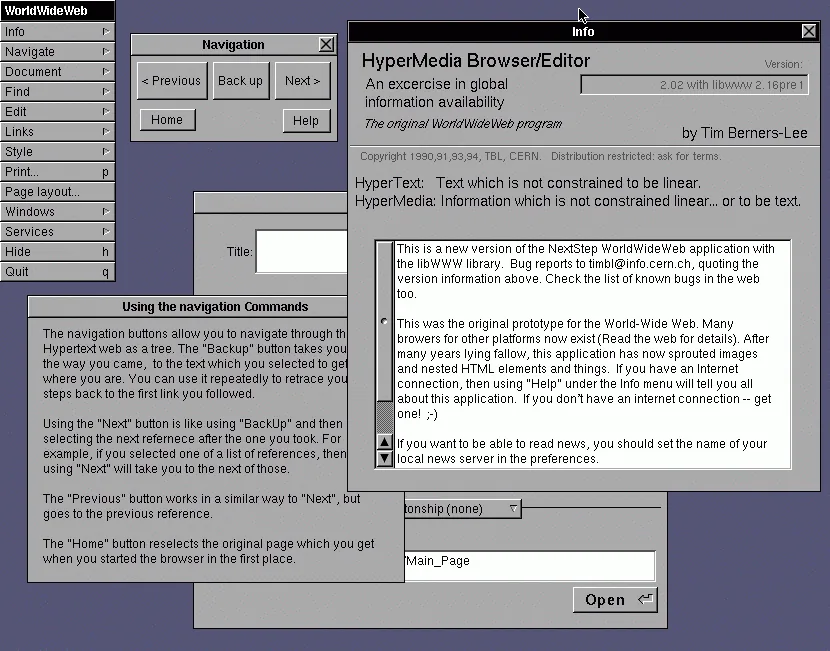
NeXTSTEP was simultaneously an operating environment and an argument. The argument was that every piece of application software should be built from reusable objects, that the display system should speak PostScript, that a programmer should be able to drag interface elements into place in a builder rather than code them by hand, and that none of this required waiting for the rest of the industry to catch up. The environment was the proof: a Mach Unix kernel underneath, BSD 4.3 utilities on top of that, and then the layer NeXT called NextStep (the Window Server, the Workspace Manager, the Application Kit, and Interface Builder) sitting above it all.8

The name created lasting confusion. "NeXTSTEP" (all caps in later usage) referred to the full shipping product. "NextStep" (mixed case) referred specifically to the upper environment layer of window management and application frameworks.7 NeXT's own early documentation used "NeXT system software" as an umbrella term covering the Mach kernel, BSD utilities, the Objective-C development system, Display PostScript, and NextStep together, plus bundled applications like WriteNow, Digital Librarian, and Mathematica.7 None of these distinctions were consistently observed in the trade press, and they still are not.

Architecture

The kernel was Mach, at the time one of the first commercial deployments of that microkernel research project.14 On the NeXTStation, Mach ran at version 2.1 on a 68040 at 25 MHz.16 Mach's contributions over a plain BSD system were concrete: a ports-based interprocess communication scheme that was faster and more consistent than traditional Unix signals, memory-mapped files, threads, and a larger virtual address space.16 NeXT leaned heavily on Free Software Foundation tooling, with gcc and gdb standard on machines with 400MB or larger disks.16 NextStep uses version 2.2 of the GNU C Compiler, handling C, C++, and Objective-C.6

Display PostScript was the rendering layer, meaning every glyph and vector drawn to screen passed through the same PostScript interpreter used by printers.7 This was elegant in theory and expensive in practice (PostScript interpretation consumed real CPU cycles), but it guaranteed that what appeared on screen was exactly what would print, at a time when that was genuinely unusual.

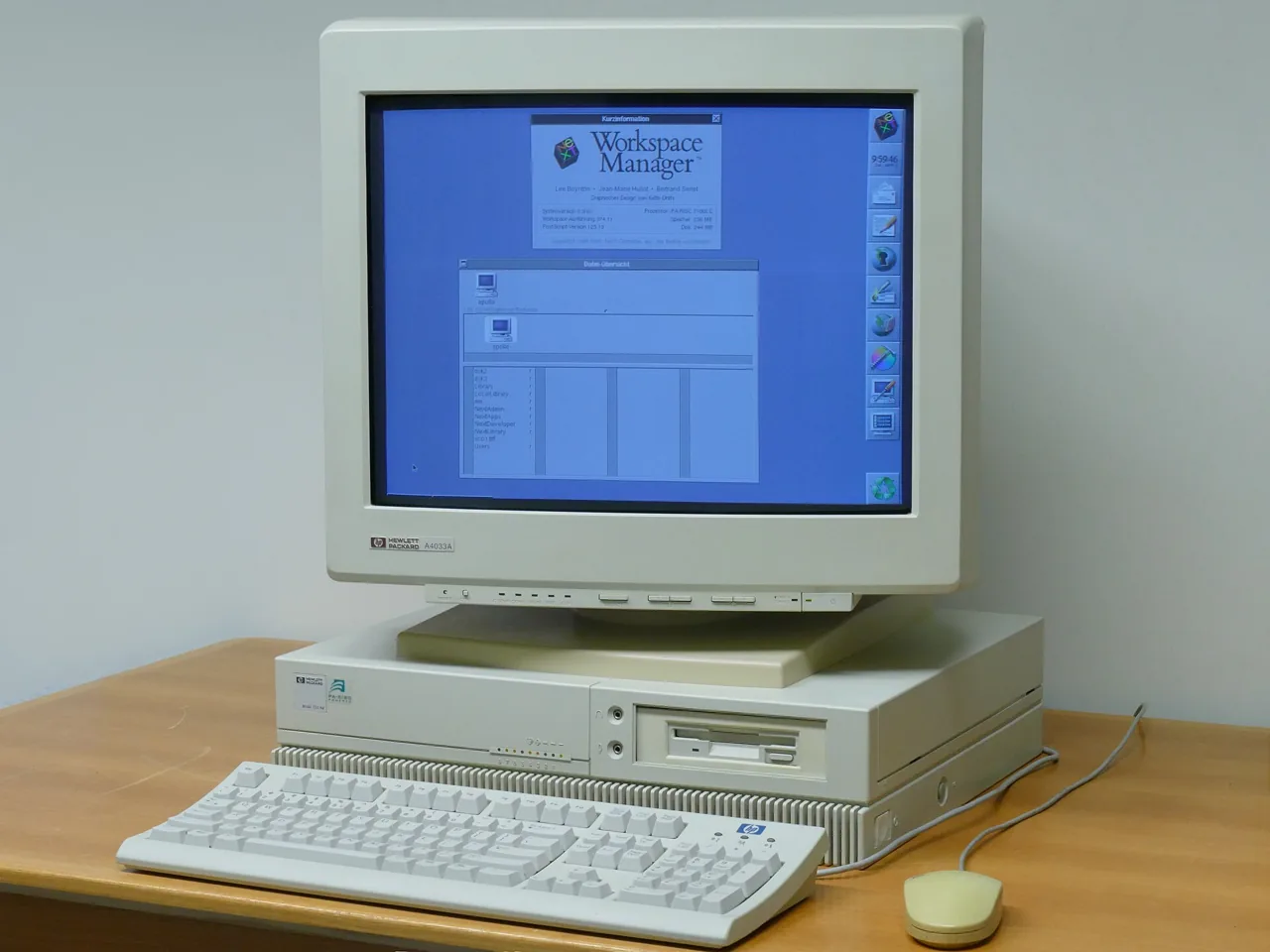
NextStep's four components divided responsibility cleanly. The Window Server managed low-level display operations.8 The Workspace Manager handled the file system and launched applications. The Application Kit provided the object framework that all NeXT programs were built against. Interface Builder let developers construct application interfaces by wiring together objects visually, which was genuinely novel in 1989 and would not be widely copied for years.8

Like any Unix system, NeXTSTEP required an orderly shutdown. On Intel hardware the procedure was to hold the right Alt key, press Num Lock, then press h to halt.3 An abnormal shutdown triggered an automatic disk check on next boot, with the system displaying "Checking disks" before cleaning the filesystem state and rebooting, behavior the service documentation described as running "an extensive check of the hard disk drive."3 The system was case-sensitive throughout, as any Mach/Unix environment would be, which caught more than a few users coming from DOS.1

Development Environment & Third-Party Strategy

NeXT's developer strategy was selective by design. The company explicitly chose to offer deep support to a small number of key developers rather than thin support spread across many, and it bundled a complete development environment with every machine so that developers could be productive immediately.9 Foundation applications like Digital Librarian and Mathematica served a dual purpose: useful to end users, but also intended as application-building blocks that third-party developers could extend.9

Objective-C was the development language throughout. The object-oriented environment was explicitly designed to tame the event-driven interface model that NeXT acknowledged made application development schedules "complicated."8 The Interface Builder approach, constructing UIs from object components rather than writing layout code, was the practical answer to that complexity.

NeXT licensed NextStep to IBM, which the company cited as a guarantee of a broader target market for prospective third-party developers.9 All NextStep applications had network capability built in by design, reflecting the environment's deep dependency on network architecture even though it was not X Window-based.11

The Intel Port & Hardware Partners

On the Epson NX, NeXTSTEP for Intel 3.1 arrived preinstalled alongside MS-DOS 6.0 and Windows 3.1 on HDD configurations.1 The Epson NX was derived from the Progression 4 basic design, with parts interchangeable between the two systems except for the main board and front bezel.1 The NX shipped in several configurations: IDE drives of 170MB (Conner CP30174E) or 240MB (Quantum LPS240AT), or SCSI configurations using the Quantum LPS525S with an Adaptec AHA-1540B host adapter, the latter coming with 36MB of system memory standard and an optional NeXTSTEP Development software bundle.1 A "bare" configuration with no drive and no software was also available.1

Canon's Advanced Technologies Operation (a division headed by two former Epson America employees who had worked on the Epson NX)4 produced the object.station, another Intel-based NextStep machine. It carried 2MB of VRAM supporting resolutions from 800×600 in 32-bit color up to 1,280×1,024 in 16-bit color, with refresh rates from 72 Hz to 110 Hz.4 The base system included CD-quality sound, an integrated microphone, a 32-bit SCSI controller with 10 Mb/s transfer rate, and 16MB of RAM expandable to 96MB, with three ISA slots and one VL/ISA slot.4 List price for the "deployment configuration" with a 500MB hard disk and a NextStep user license was $5,394; without the license, $4,797.4 An optional 17-inch color display added $1,181.4

OpenStep & the Move Toward a Standard

By 1994 NeXT and Sun were jointly promoting OpenStep, an open API specification derived from the operating system-independent subset of NeXTStep 3.2.10 SunSoft committed to licensing NeXTStep's application environment for integration into Solaris enterprise software, while NeXT agreed to license the APIs and the OpenStep trademark freely to any implementation that passed the OpenStep test suite.10

Sun's OpenStep Starter Kit, available while Sun's own Distributed Object Environment (DOE) was still in development, was straightforwardly an exact copy of NeXT's NextStep 3.2 User and Developer packages.6 The intent was transparent: let Sun developers learn the environment before DOE 1.0 shipped, with the expectation that OpenStep applications would port within weeks of DOE's release.6 Hewlett-Packard was set to launch the first PA-RISC NextStep workstations at the NextStep Expo.5 An Atari port circulated as a rumor on BBS networks; Atari's own John Townsend publicly stated that he had no knowledge of any such port and that Atari had no business relationship with NeXT, Inc.12

Eric Bergson, managing director of Objective Technology, a New York firm selling NextStep applications and object libraries, characterized the expected OpenStep market as resembling NeXT's existing one: "large-scale, mission-critical application development and custom software."6 That was a diplomatic way of acknowledging that NeXTSTEP had never been a mass-market operating environment. It was always a specialist tool commanding specialist prices.

The Archivist's Take

NeXTSTEP's influence is comically disproportionate to its market share. The environment shipped Mach to paying customers before almost anyone else.14 It had online help (contextual, launchable, hypertext) when OS/2 PM and Windows 3.0 were the only serious competitors to offer anything comparable.11 Interface Builder prefigured decades of visual development tools. Objective-C went on to power iOS and macOS. The documentation even bundled Mathematica as a first-class citizen.7

What NeXTSTEP never solved was volume. The hardware was expensive, the developer pool was small by design, and the Intel port, though real and shipping, arrived into a PC market that had already committed to Windows. The object.station at $5,394 and change was a serious machine for serious buyers, not a platform with broad commercial gravity.4 NeXT knew this, which is why licensing to IBM and courting Sun mattered so much.9 The OpenStep gambit was the last attempt to turn a compelling engineering achievement into something the rest of the industry would actually adopt at scale. It half-worked, which, given what came after, turned out to be enough.

References

  1. epnx ps
  2. epnx u1
  3. SunExpert-v05n10-1994-10 (1994)
  4. SunExpert-v05n05-1994-05 (1994)
  5. SunExpert-v05n07-1994-07 (1994)
  6. NeXT 0.9-1.0 Release Description
  7. 1989 03 BYTE 14-03 Mac Supplement 286 vs 386sx Object Oriented Programming (1989)
  8. NeXT Third Party Programs and Products
  9. SunExpert-v05n02-1994-02 (1994)
  10. Byte Magazine Atari Articles
  11. STR818.TXT.generated
  12. cryptolog 116
  13. AUUGN-V12.45