Commodore 1541 Disk Drive (1982–1986)
It was a whole computer in its own beige box, bolted onto your computer — and somehow that made it slower, not faster.
Overview
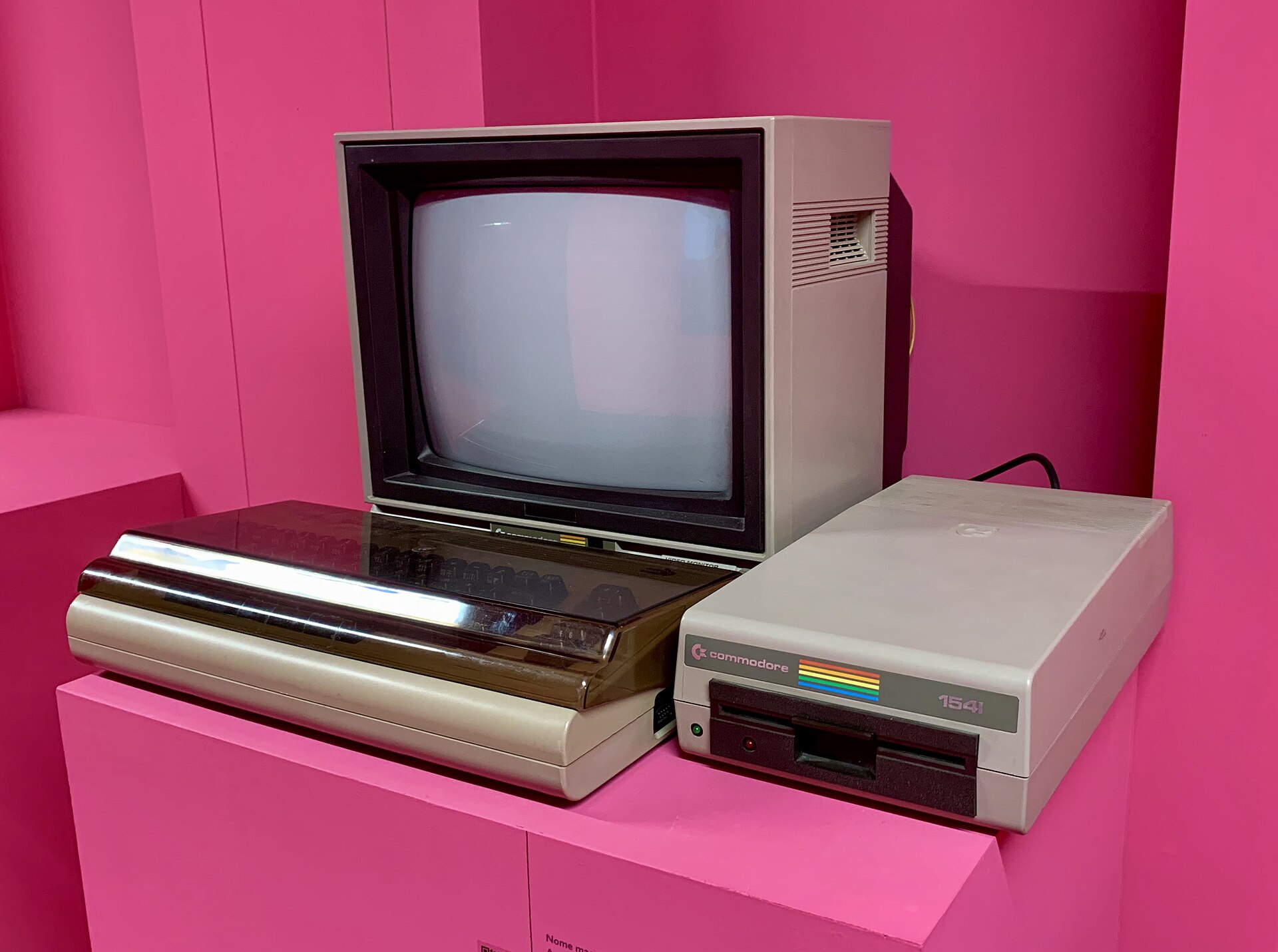
The Commodore 1541 is the disk drive most people picture when they picture the Commodore 64. For millions of home users in the early 1980s it was the upgrade that turned a games-and-BASIC machine into "a powerful information-handling system," somewhere to keep files and programs that wasn't a cassette tape. It stored a little over 170K on a single 5.25-inch floppy, daisy-chained to the computer over Commodore's serial bus, and it did so with a peculiar architecture that makes it one of the most interesting peripherals of the era: the 1541 is not a dumb drive. It is an intelligent peripheral with its own microprocessor and its own operating system, a small computer in its own right whose entire job is to manage another computer's disks.
That design is the key to understanding the 1541, for both its strengths and its legendary faults. Because the drive runs its own Disk Operating System (DOS), as Commodore's documentation stresses, that DOS "occupies no space in the memory of the Commodore 64 or VIC-20." The host computer simply transmits commands and the drive executes them on its own, leaving the computer's precious RAM free. It was an elegant idea inherited from Commodore's earlier, larger business drives. It was also, in practice, the source of the 1541's enduring reputation for running hot, drifting out of alignment, and being almost comically slow.
What It Does & How It Works
The 1541 is a self-contained system: every component needed to control and operate it lives inside the drive's own case, so it draws nothing from the computer except commands. Internally it is a genuine little computer: its own microprocessor, a 16K control system (the DOS) in ROM, and a small bank of RAM organized as data buffers (Buffer 0 through Buffer 4, occupying $300–$700 in the drive's address space). As the Anatomy of the 1541 describes it, the drive performs three tasks simultaneously: it manages the data traffic to and from the computer, it interprets the commands it receives, and it handles file management on the disk, all without borrowing the host's processor time.
On the disk itself, the 1541 lays down 35 tracks, each holding between 17 and 21 sectors, for a total of 683 sectors of 256 bytes each. Track 18 is reserved for the directory, leaving 664 sectors (about 163K once file overhead is accounted for) available for data, and room for 144 directory entries. Each sector is given an address and a format code (the 1541's code is 2A) so the DOS can identify both its position and whether the disk was formatted by this type of drive. Storage was a genuine leap over cassette: an 8K program could be saved in under fifteen seconds, which the Commodore manuals, comparing it to tape, present as downright fast.
On the front are a slot and two indicator lights: green for power, red for data activity or drive errors. On the back are the power switch, the AC cord receptacle, a fuse holder, and two Commodore serial ports, which let the drive be daisy-chained to a second drive or to other serial peripherals. And there is the rub. The 1541 talks to the computer over Commodore's serial bus, one bit at a time. Its near-identical sibling, the CBM 2031, has the exact same functions, construction, and operation, but connects over the parallel IEEE bus instead, which yields a markedly higher transfer rate. The 1541 traded speed for the cheap, simple serial cabling that made it affordable for a home machine. That trade is why "1541" and "slow" are, for a generation of Commodore users, nearly synonymous.
Compatibility & Quirks
The 1541 connects directly to both the Commodore 64 and the VIC-20 over the serial bus. It was, in fact, the only Commodore drive that could attach directly to those machines this way. But the two computers need different data-transfer speeds, and the drive handles this with a quiet trap for the unwary: at power-on the 1541 defaults to the Commodore 64's timing, so a VIC-20 owner has to issue a speed-change command immediately after switching on, every time, or risk trouble.
The drive also carried a lineage worth knowing. The first generation was the VIC-1541 (also sold as the 1540, the VIC-20's drive). Commodore later took the discrete components on the VIC-1541's disk-controller board and combined them into custom ICs, renaming the result the 1541; functionally the two are nearly identical. The family ran upward from there to the larger CBM 4040, 8050, and 8250 business drives, the 8250 packing over 500K and a later DOS that could stretch a single relative file to 23 MB.
Then there is the failing for which the 1541 is genuinely notorious: head alignment. The read/write head must be mechanically aligned to the physical tracks, and Commodore's own maintenance guide warns that a truly accurate alignment requires a reference disk and test software, and that a drifting alignment "may cause compatibility problems when using software recorded on other drives." Combined with a power supply that ran the drive warm enough that the maintenance procedures carry repeated, blunt warnings about high AC voltage potentials that "can cause bodily injury or even death," the 1541 earned a reputation as a device that worked beautifully right up until, one day, it didn't.
Significance
The 1541 mattered because it was the storage device that an entire generation of Commodore 64 owners actually owned. It was cheap enough to put a real disk drive in a bedroom, clever enough to keep the host computer's memory free, and ubiquitous enough that its quirks (the slowness, the heat, the alignment drift, the cryptic error light) became shared folklore. Its serial-bus bottleneck spawned an entire cottage industry of "fast loader" cartridges and software that worked around the drive's own DOS, an arms race that is itself a defining piece of 1980s home-computing culture. To understand the Commodore 64 experience is to understand the patient whir of a 1541 loading a program.
The Archivist's Take
The 1541 is a beautiful contradiction. On paper it is the more sophisticated design, an intelligent drive with its own brain, sparing the host computer the work. In practice that sophistication is exactly what made it slow, hot, and fragile. Commodore put a complete computer inside the disk drive and then connected it to the actual computer through a straw. You can read the whole personality of early Commodore in that decision: brilliant engineering, ruthless cost-cutting, and a serene indifference to whether the end result was fast.
For the collector, the 1541 is essential and exasperating in equal measure: the most evocative object in the Commodore ecosystem, and the one most likely to need its head realigned before it will read a forty-year-old disk. Keep one working and you keep the actual Commodore 64 experience alive, slowness and all. That slowness wasn't a defect of the era; for these machines, it was the era.
Specifications
| Manufacturer | Commodore |
| Type | Intelligent 5.25-inch floppy disk drive (single-sided) |
| Predecessor | VIC-1541 / 1540 (first generation) |
| Interface | Commodore serial bus; two ports (daisy-chainable) |
| Onboard intelligence | Own microprocessor + 16K DOS (ROM) + RAM data buffers (Buffer 0–4, $300–$700) |
| Capacity | ~170K total (~163K usable); 144 directory entries |
| Disk format | 35 tracks, 17–21 sectors/track, 683 sectors total (664 usable; track 18 = directory), 256 bytes/sector, GCR, format code 2A |
| Typical speed | ~8K program saved in under 15 seconds (slower than IEEE-bus siblings) |
| Compatible hosts | Commodore 64 and VIC-20 (different transfer speeds; defaults to C64 timing at power-on) |
| Family | CBM 2031 (parallel IEEE, faster), 4040, 8050, 8250 (larger business drives) |
| Indicators | Front: green (power), red (data/error); Rear: power switch, AC inlet, fuse, 2× serial ports |
Sources
This article is drawn from documentation in the Computopedia archive:
- The Anatomy of the 1541 Disk Drive (Abacus Software)
- 1541 Disk Drive Maintenance Guide (Commodore, 1984)
- Compute! — Compute!'s Commodore Peripherals ("The 1541 Disk Drive")