PDP-8
Digital Equipment Corporation’s PDP-8, introduced after the company's 1957 founding as a maker of digital logic modules, became the first general-purpose computer to sell for under $20,000, reshaping accessibility in computing14.
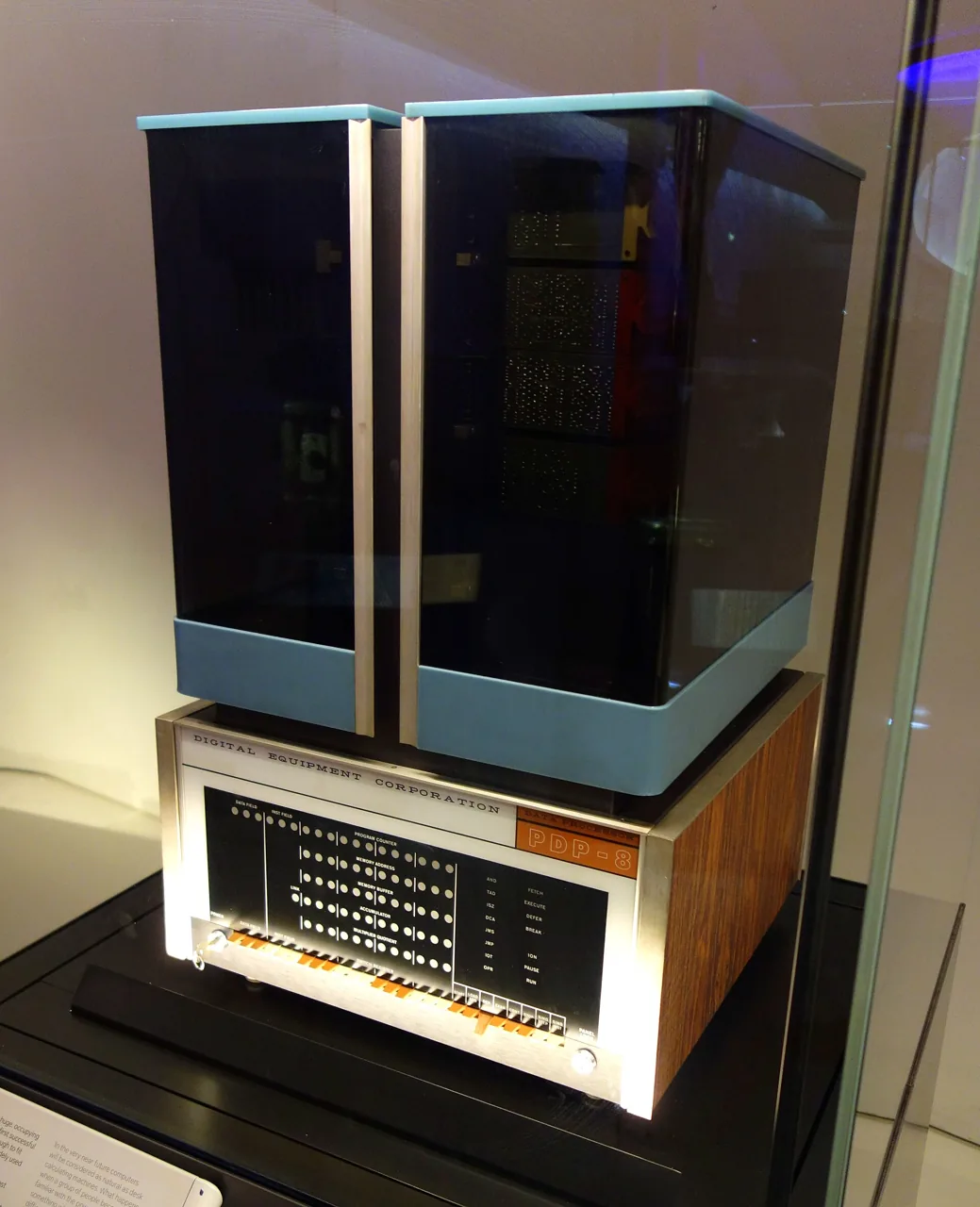
The PDP-8 established a new threshold in cost and scale for general-purpose computing, targeting users priced out of larger systems. Its 12-bit word architecture6 formed the backbone of a family that evolved across multiple models, each balancing performance, expandability, and cost. The original PDP-8 was succeeded by variants including the PDP-8/S, PDP-8/L, and PDP-8/I, with later iterations like the PDP-8/E, PDP-8/F, PDP-8/M, and PDP-8/A extending its lineage123568. By July 1969, the PDP-8 and PDP-8/S were no longer in production, supplanted by the PDP-8/L and PDP-8/I13.
The PDP-8/S implemented a serial architecture, meaning data transfers between registers occurred bit by bit through the adder, drastically reducing logic complexity compared to parallel designs4. This design choice allowed for a simplified component count: the PDP-8/S logic complement included 92 flip-flops, 161 inverters, 160 NAND gates, 62 diode gates, and 70 drivers for displays, alongside clocking and timing elements such as 2 clock multivibrators and 2 one-shot delays4. The system used a 4K, 12-bit memory4, and while the memory cycle time is incompletely documented, it was based on a 6-microsecond timing reference4.
The instruction set centered on eight basic memory-reference instructions5, a minimal but functional core that enabled broad software development. The machine ran OS/8, under which cross assemblers known as the X8 series operated in 8 K words of memory11. These assemblers supported a range of contemporary microprocessors including the Z-80, 1802, SC/MP, 8048, 6502, 6800, 8080, F8, and 265011. Object code could be output in target microprocessor loader formats or BNPF for ROM programming, and the tools were distributed on paper tape, DECtape, or DEC floppy diskette in PDP-8 binary format11. The X8 series was priced at $40011, and additional software such as FOCAL was available for a nominal fee15.
At the lower end of the product line, the PDP-8/L was introduced as a stripped-down model without plug-in expansion capability, designed specifically for users whose needs were limited to basic I/O via an ASR33 Teletype413. It carried a price of $8,500 for a 4K memory configuration13, $1,500 less than the standard PDP-8 at the time4, with a maximum core memory of 8K13. In contrast, the PDP-8/I included an internal peripheral control and data-break panel for expansion, offered faster operation, and was priced at $12,800 in rack-mounted form with 4K memory and ASR33 TTY13.
Despite its architectural simplicity, the PDP-8 fostered a diverse software ecosystem and inspired derivative designs. The Fabri-Tek MP12 was noted as being nearly software-compatible with the PDP-85, and Intersil announced plans to develop a full CMOS-based implementation that could yield a portable, pocketsized version of the machine5. Emulation efforts emerged early: one developer reported writing two PDP-8 emulators, one on a Control Data 6400 and another on a PDP-8 itself12.
Terminal compatibility extended to certain Tektronix models, specifically those recognizing DEC PDP-8 units with serial numbers 150 and above10. The machine’s influence is evident in its role in democratizing access to computing power: its sub-$20,000 price point14 and subsequent models under $10,00014 altered the landscape of institutional and industrial adoption. However, the surviving documentation is silent on exact release dates, physical dimensions, clock speeds, register layout, and total production volume.
References
- DEC CommunicationServicesPublicationsIndexJuly1972 (1972)
- 16-(325)-1062-1A-R972 PDP-8F EngineeringDrawingsMay76
- Multi-Tasker May-June1982 (1982)
- ACS Newsletter 1 7
- ACS Newsletter 3 7
- MAKE Magazine OH 05
- 18bitServiceList1972 (1972)
- Dec-PDP8e-Sales-Lit
- DeVIAS-Multitasker February1984 (1984)
- Tektronix Terminals 1969-1993 (1969)
- 1978 11 BYTE 03-11 The Sky is the Limit (1978)
- 1976 11 BYTE 00-15 More Fun than Crayons (1976)
- ACS Newsletter 2 1
- 102638145-05-01-acc
- ACS Newsletter 3 1